
What Happened to The Reading and Leeds Festivals?
Every year, as the August Bank Holiday weekend approaches, the Shiiine On Festival shares an old Reading & Leeds lineup to their Instagram.
Something like this:
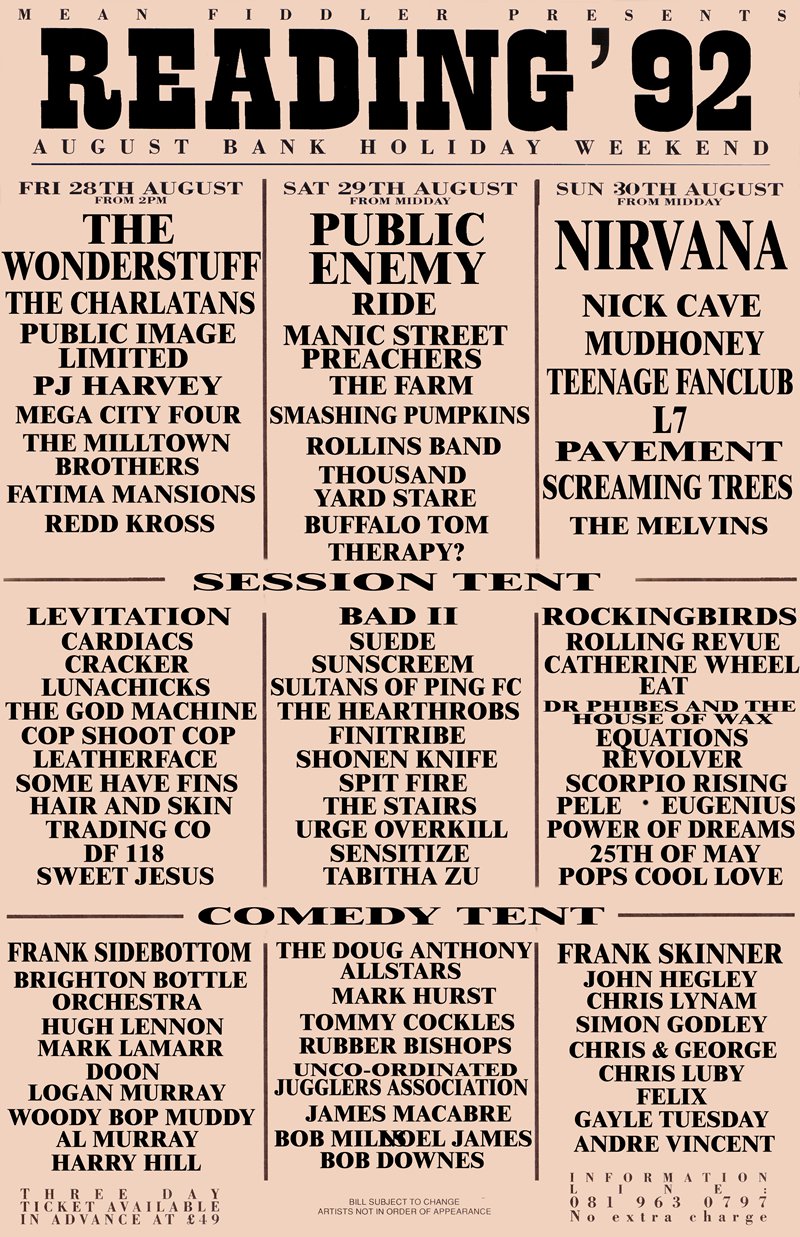
You can imagine the comments. Some just offer a single word. “Classic,” or similar. Some share fond memories. This is often something along the lines of, “I can’t remember much but I’m told I had a good time”. They were drunk, you see.
But others say something along the lines of “what happened?”
And you get similar comments whenever Reading and Leeds post lineup updates to their own social media profiles. “What happened?”
What happened, indeed?
Well, this happened:

Long story short: We all got older. The world moved on without us.
Yes, there are still a few names that jump out here and there. But the days when we could have spent entire weekends drifting in delirium from one stage to another are long gone, and they’re never coming back.
These posters might look like a list of acts spread across numerous stages, but for us, they might as well read: This isn’t for you anymore. You don’t belong here.
It’s a fair cop. Reading is the UK’s longest-running festival, and we can’t very well expect it to always cater for our dusty tastes. But still. It rankles to see a pop festival wearing the skin of an “alternative” festival we once held dear.
Reading and Leeds has never stayed in one shape for very long. It started life as a jazz festival, after all, before morphing into some kind of hard rock/arena pop monster. The festival as we knew it and loved it – the indie/rock/metal/punk paradise – had only been around since 1989, and it didn’t even come to Leeds until 1999.
But I often wonder, when I compare today’s dispiriting lineups to the lineups of yore – at what point did it change?
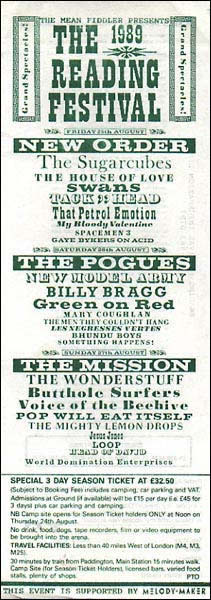
Did it shapeshift overnight, as it were, like it did between 1988 and 1989? In 1988, they tried to make it a mainstream, commercial pop festival. Meat Loaf was bottled offstage. In 1989, Mean Fiddler took over, and put on an astounding weekend of goth, indie, shoegaze, folk, grebo, and world music:
Or maybe THE FALL, as I cannot help but think of it, was more gradual? Every year, more clutter, more repetition, fewer surprises, and fewer things I’d happily see. And then, before you know it, the kids are happily bopping to Post Malone (or whatever one does to the music of Post Malone), while the dead flowers crumble into dust on my grave.
So was the fall of Reading a slow rot or a sudden upheaval? To find out, I listened to as many acts as I could that appeared at the festival from 1989 onwards, roughly in order of appearance. This meant listening to over 1,200 bands, solo acts, rappers, and DJs. It took me about three weeks.
Reading (And Leeds) Before The Fall
To summarise, it was enormously enjoyable to listen through every lineup between 1989 and, give or take, 2000. Of course I didn’t enjoy every act that ever appeared. Billy Bragg played on a number of occasions, after all. Yet throughout the 90s, almost every lineup now seems too good to be true.
Every 90s poster has the power to make people like me misty eyed when we see them. One tends to wonder if the world ever really made this much sense. Was it really possible for bands like The Jesus Lizard, The Butthole Surfers, and Primus to play the main stage at a major music festival?
Some years were particularly blessed. Look at the state of 1995:
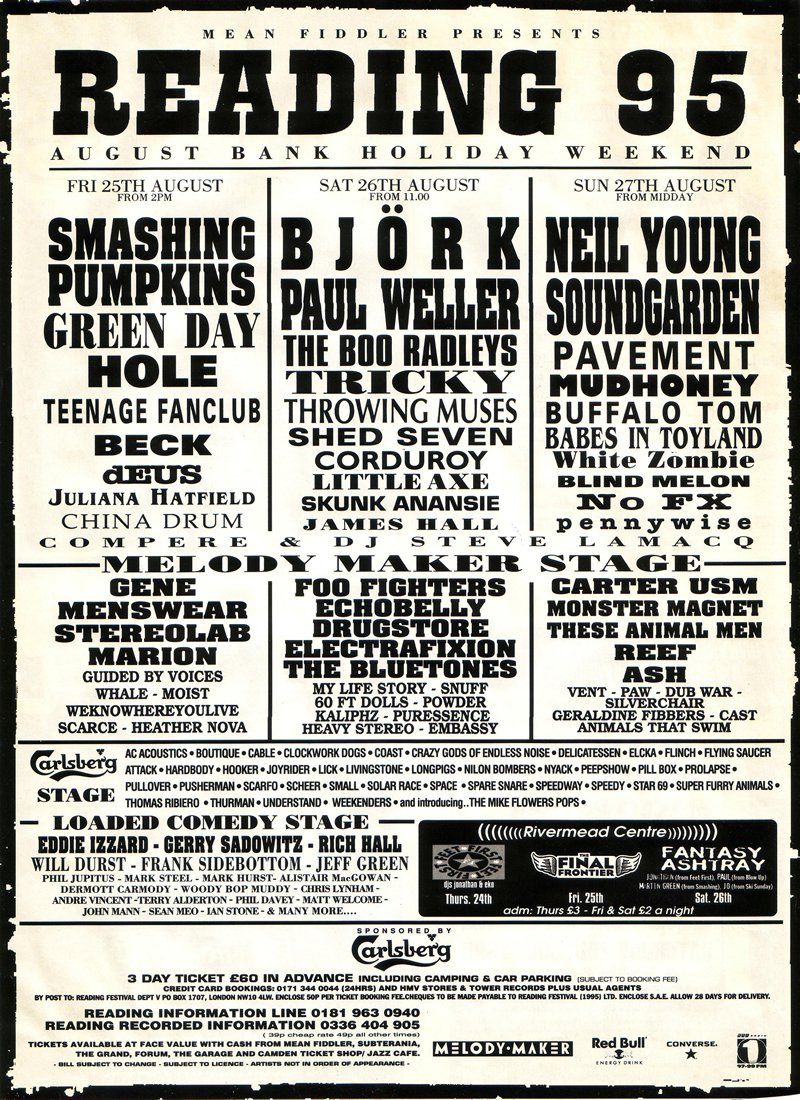
The Smashing Pumpkins, Björk, and Neil Young headlined. Neil Young played with Pearl Jam as his backing band. Back-to-back beatific Britpop bliss on the Melody Maker stage. Super Furry Animals, Flying Saucer Attack, and Space on the Carlsberg stage. For God’s sake.
And while we’re at it, look at the state of 2000:
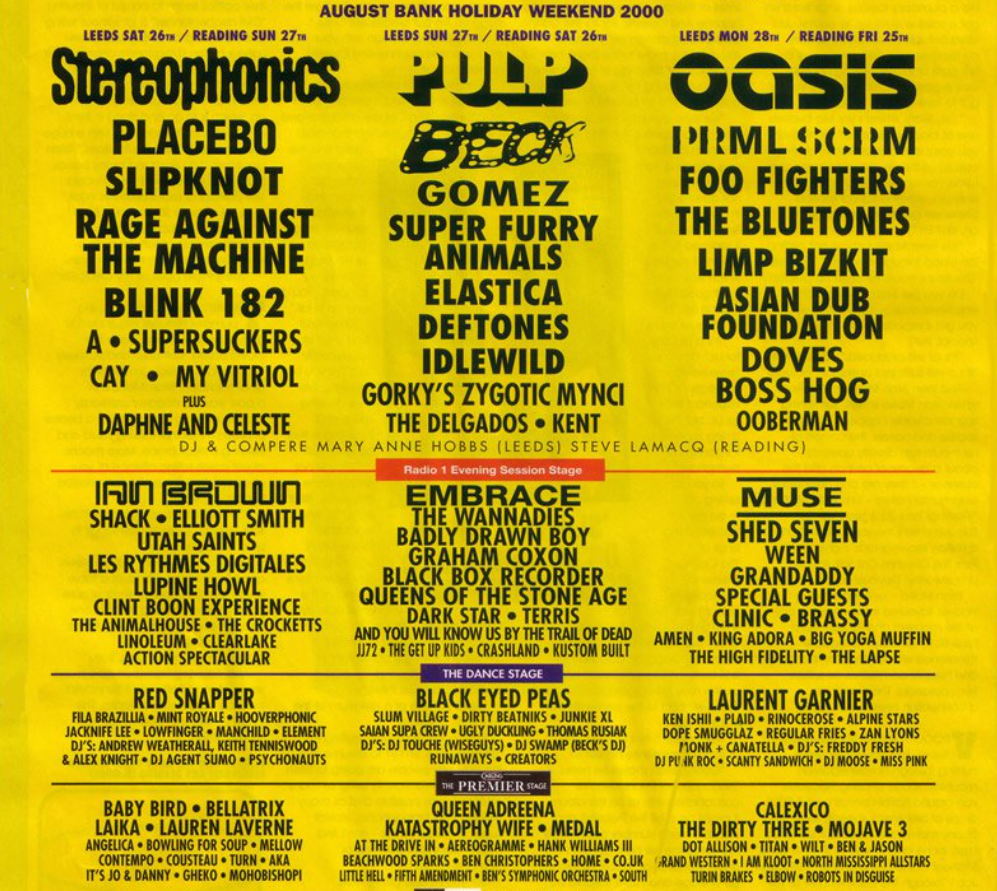
Despite showcasing pretty much every Britpop band in their heyday, they weren’t able to secure Oasis until 2000. Shamefully, this was the year Daphne & Celeste got bottled off. The modern festivals may look appalling to me, but we can at least assume that Daphne & Celeste would get a kinder reception these days. But anyway.
This is just embarrassing. Foo Fighters, Doves, Ooberman, Beck, Gomez, Super Furry Animals, Gorky’s Zygotic Mynci, The Delgados… and that’s just the main stage! Further down, Ween, Grandaddy, Clinic, Badly Drawn Boy, Queens of the Stone Age, Trail of Dead, Sleater-Kinney, Elliott Smith. The “Special Guests” under Muse on the second stage were Royal Trux. I repeat myself, but for God’s sake.
Yet already there are signs of decline. Every band that played on the mainstage on the Saturday had already played the festival before. Plus, this marks the start of a dubious trend whereby acts who played the second stage one year would be promoted to the mainstage the very next year, with acts that played the third stage in turn getting promoted to the second stage. It’s from this point that the lineups start to feel a little repetitive.
The music gradually starts to change shortly after this, too. At first you notice it in the heavier bands: They get bleaker, angrier, and screamier. But the good still outweighs the bad, and you still get lots of too-good-to-be-true runs of bands.

In my book, the last truly good year was 2005. This was the last year at which I could happily have spent an entire day at a single stage. Indeed, I nearly did! I went to the Leeds festival in 2005, and I watched every band on the mainstage on Saturday between the “Special Guests” (who turned out to be Goldie Lookin Chain) and The Coral. I had to head to the NME stage then, to watch The Cooper Temple Clause and Black Rebel Motorcycle Club back-to-back (for God’s sake). And to my regret, I watched Kasabian instead of Pixies. But that’s another story.
On Friday afternoon Four Tet took our minds on a journey to meet our souls. Friday night was peaceful and bleary – a double header of what the NME was then calling “nu-gaze” with Amusement Parks on Fire and Engineers, followed by Echo & The Bunnymen. On Sunday, to my enduring pride I chose to watch Roots Manuva and Dinosaur Jr instead of Arctic Monkeys, who apparently had A Moment as they played to a packed Carling Stage. Then later on, we all got emotional watching Arcade Fire, and I had my first Foo Fighters experience, when they opened with In Your Honor followed immediately by All My Life.
For God’s sake.
Ah, it was a great weekend. We didn’t know how good we had it.
The Fall of Reading (and Leeds)
So in 2006, the rot set in.
I went to the Leeds leg of this one, too. Once again, I had a fantastic time. I saw Muse and Animal Collective for the first time – the latter changed me on a cellular level. Watching Mastodon was my very first experience seeing any live metal. The Secret Machines were beautiful; The Dresden Dolls covered The Kaiser Chiefs (I believe Amanda was dating Ricky at this point); and Hope of the States played some of their last ever shows, closing their set with Enemies/Friends. Once more: For God’s sake.
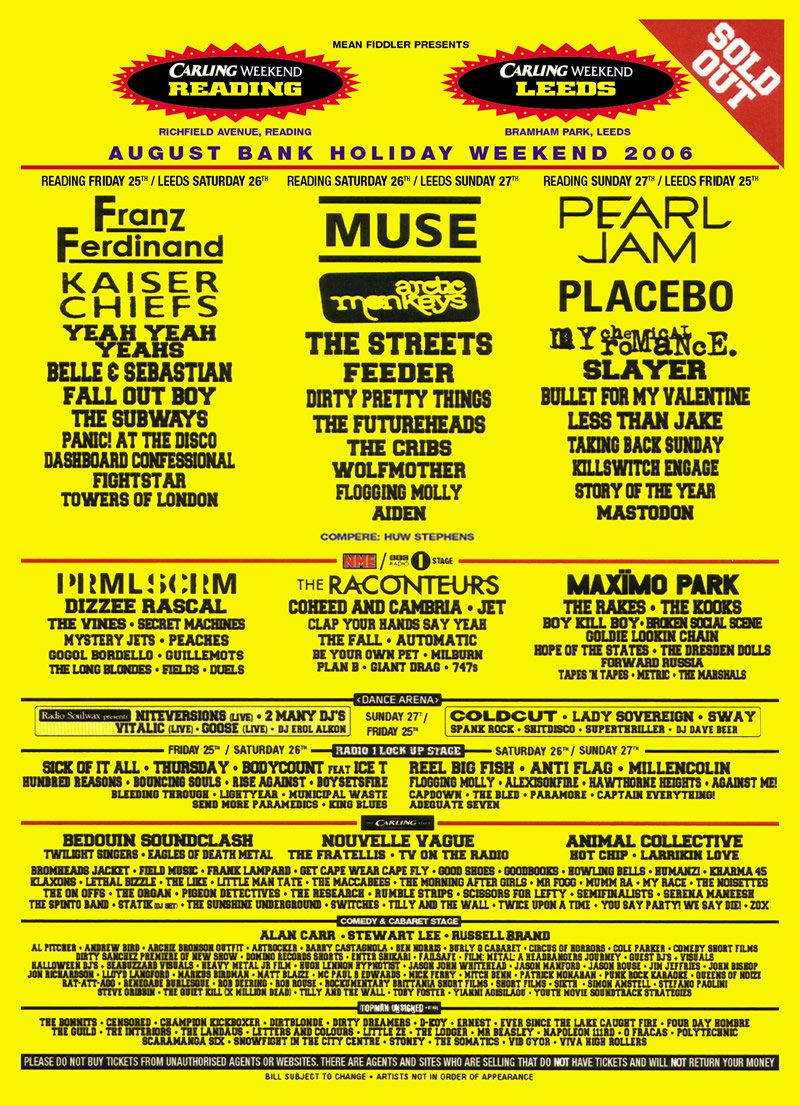
But oh, evil was lurking in the depths of the Carling Stage lineup. Among legendary hearts such as TV on the Radio, Noisettes, Field Music, and Tilly and the Wall, we got the vanguard of the asinine “new rave” movement, and that hideous sub-sub-sub class of guitar music that would ultimately be referred to as “landfill indie”.
You know the type – trebly guitars, yelpy vocals, and chirpy songs about nightclub bouncers. It’s here, it’s horrible, and from this point on it would be impossible to escape. Remember, at this time it was common for acts playing on lower stages to graduate to larger stages in subsequent years. This is why I say that, in 2006, the rot set in. These unimaginative also-rans would soon be plaguing the larger stages with their dreary music, while grotty new bands with even less inspired songs would fill the spots they’d vacated on the smaller stages.
Don’t get me wrong! There was still much to love in many of the subsequent festivals. 2007 saw the return of Smashing Pumpkins (who I’m told played a bewildering set of deep cuts, but whatever), while Nine Inch Nails made their Reading/Leeds debut. 2008 is less impressive, but I’d still be able to find enough treasure amid the landfill to make the weekend worthwhile. 2009 seems similarly underwhelming. But then, Radiohead played, so it gets an automatic pass.
And so the trend continues: Every year there’s less I’d want to see, along with fewer things that we’ve never seen before. Yet still, there’s generally enough there that would have made the weekend worthwhile. It just would have taken more beer than would have been necessary in previous years. And at a festival that was once sponsored by Carlsberg and Carling, drinking copious amounts of beer isn’t exactly an appealing prospect.
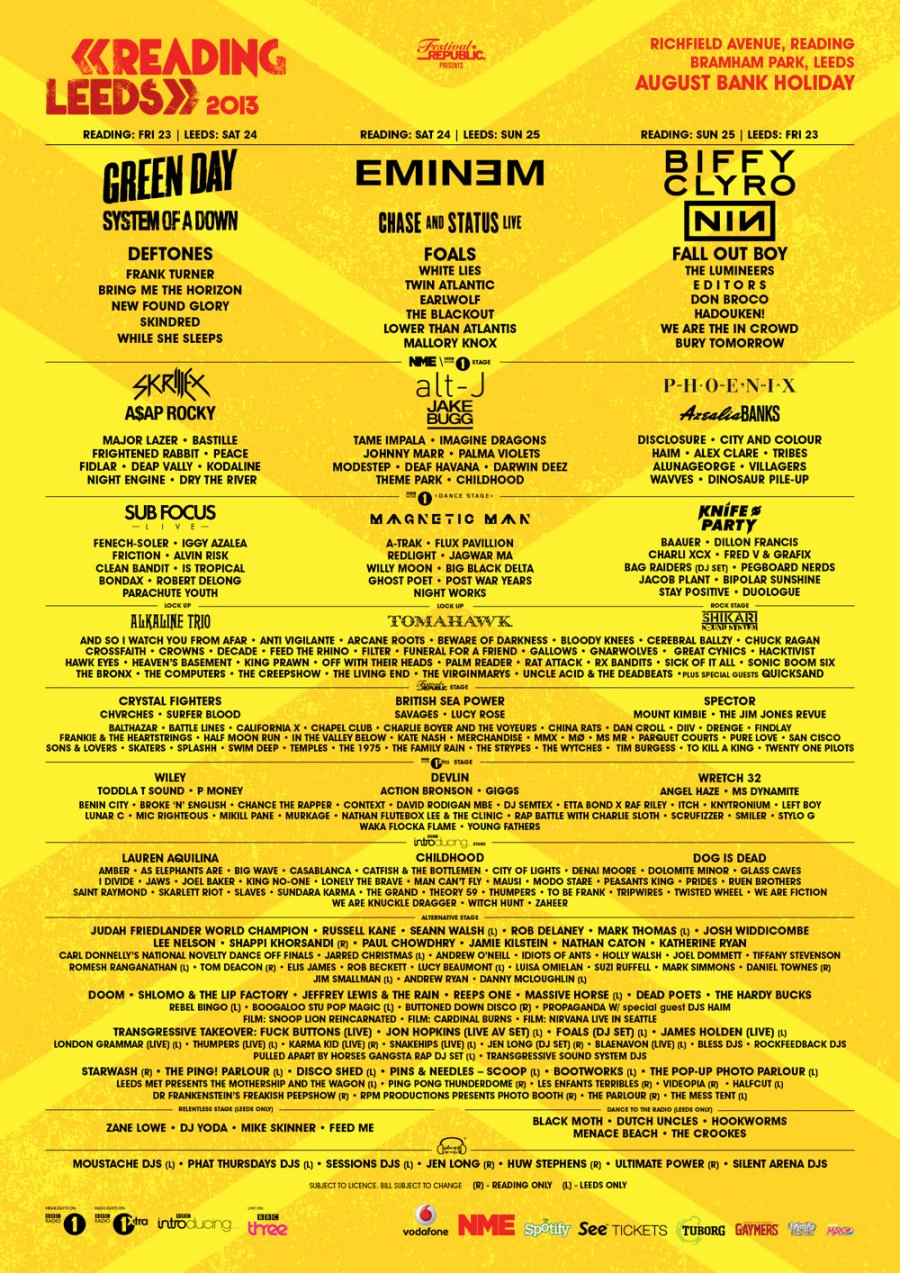
I believe 2013 is the first year at which the bad outweighs the good, when I really would have struggled to find enough things worth seeing each day. Even the poster looks wrong, somehow, with its tiny text, its new font, and the big gaps between the columns. For me, the weekend for me probably would have peaked with Nine Inch Nails’ early evening set on the Friday. After that, it would be quite a slog to get to Alt-J’s second stage headline set on the Sunday.
By 2014, you have a messy co-headlining situation (Queens of the Stone Age and Paramore), along with a prominent billing for Macklemore. This strikes me as a point of no return. From this point on, the decline is rapid and depressing. But things only get really bad in 2019. There’s a headline set by The 1975, who would headline two out of three of the next few festivals. There’s another co-headline mess, this time involving Twenty One Pilots and Post Malone (for the kids to bop to). And most ominous of all, the NME/Radio 1 stage was now just the Radio 1 stage. The “alternative”, if it ever existed, is now gone for good. The state broadcaster now has full control.
Look How They Massacred My Boy

Yes, the festival took a year off in 2020. But when it returned in 2021, it was irredeemable. Two main stages with staggered sets replaced the old main stage/second stage hierarchy. A further headline set for Post Malone (those kids just love bopping!). And for me, there’s a slight feeling of uncanniness when I look at this lineup, as if parts of it have been generated with AI. A lot of the acts have names that don’t even register as words. And while you can’t really see it due to this poster’s formatting, many of the acts write their names all in lower case, or worse, ALL IN UPPER CASE, which I find deeply irritating for reasons I cannot articulate.
So, I got older. The festival now caters for people who aren’t me. The festival is now for people who are younger than me, who don’t care about Mercury Rev, but who love pop, rap, dance, sad singer songwriters, and bopping to Post Malone (one assumes).
Were I a gunslinger, I might argue that the Reading festival has forgotten the face of its father. But this is OK. This is the natural order of things. This is the way it’s supposed to be. This was always going to happen. And yet, the regret. The feeling that something’s been lost forever, the uneasy notion that there is no counterculture to speak of anymore. I’m not sure we should be OK with that.
Relive Reading (and Leeds) Before The Fall
Yes, I made a playlist of all the stuff I listened to from 1989 to 2009. I stopped in 2009 because that makes for 20 years and, like Waltzing Matilda in Street Hassle, I like round figures. But also, as I mentioned above, from 2009 the decline is so advanced that far too much of the music was too dreary for words.
I followed the same rules as I did for my ATP playlist: Each act only gets featured once, and I can only include songs that they might have played during their initial appearance at the festival – so, stuff they’d already released. For example, when including Red Hot Chilli Peppers on the back of their initial 1994 appearance, I could not include any songs from, say, Californication, which would not be released for another five years.
I relaxed this rule a little with the smaller bands, reasoning, for instance, that a band who appeared in 2003, but who wouldn’t release their debut in 2004, might still perform some songs from said as-yet-unreleased debut.
Also, I broke this rule twice with the very first song on the whole playlist. Half Man Half Biscuit would not appear at the festival until 1990, and they would not release Running Order Squabble Fest until 1993. But it was so funny and fitting a song to open the playlist with that I couldn’t resist.
Of course, I’ve not included every act that played at every festival. Some of them weren’t on Spotify. And there were many cases where I find the music, or the musicians, so repulsive that they were never going to make it.
As much as possible I’ve tried to go for bouncy, lively, heavy, fast, or otherwise uplifting songs. This is a festival playlist, after all.
The biggest surprise for me, when making this list, was how much I clicked with late 90s and early 00s American punk, pop punk, and ska punk. It’s relentlessly upbeat sunshine music for summer inebriation! I’m reminded of how happy I felt seeing American Pie 2 at the cinema, with its chirpy pop punk soundtrack, and how striking the contrast was when we left the cinema to a grey and drizzly afternoon. To go from a run of limp indie bands to something bright, melodic, and energetic from California was always a treat.
I remember getting ready to go to the 2006 Leeds festival, and complaining about how there was only one “dance day” this year, with two “rock days” instead. Someone from Yorkshire said, in his Yorkshire way, “eeeh, thars don’t know what’s good for thar, lad.” Or something. He was right.
 Lord Gloom