
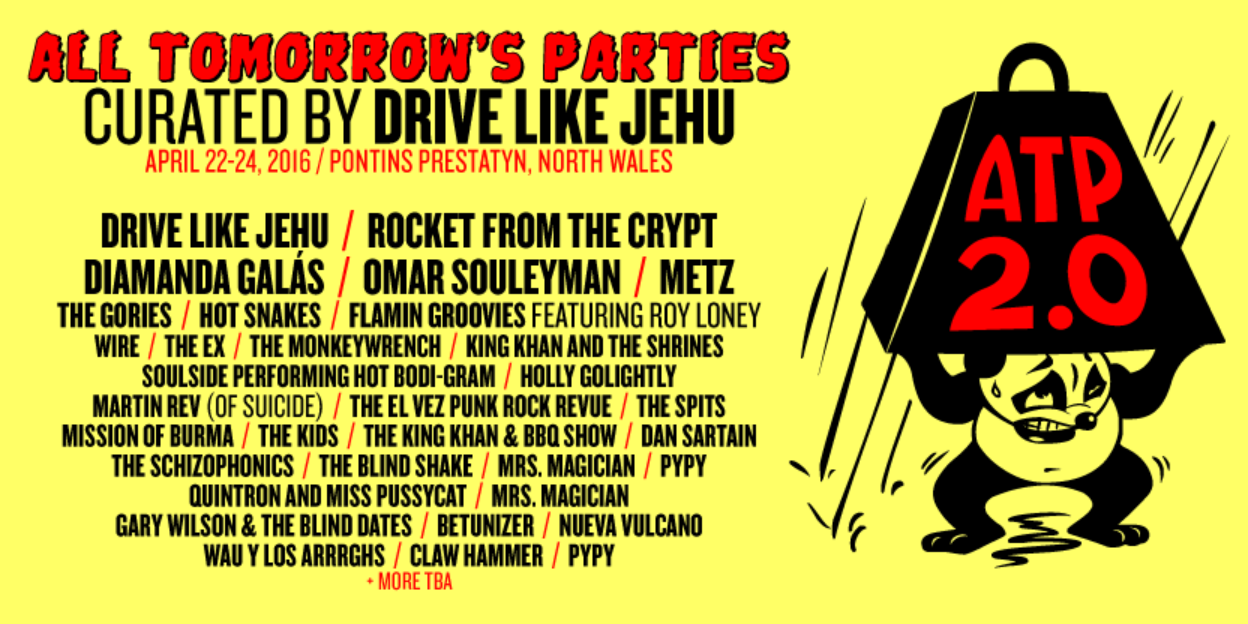
All Tomorrow’s Parties (ATP) was a series of festivals held between 1999 and 2016.
These festivals were remarkable for a number of reasons. First, their lineups were almost entirely hand-picked by a guest curator, who was usually a musician. Second, many of the festivals took place in the most refined environments possible – Butlin’s holiday camps! Yes, this means that for one glorious evening it was possible to see Patti Smith play on a stage usually used for knobbly knees contests.
Third, the various acts on the lineup were obliged to stay in exactly the same chalet accommodation as the guests, while using the same facilities. I’ve heard stories of Nick Cave observing the action at a pirate-themed mini golf course (not playing, just observing); and of Sigur Rós walking into the starkly lit Butlin’s canteen for their dinner and looking faintly horrified.
This mixing of guests and acts could, I think, have gone either way. While it’s nice to imagine you might have enjoyed a walk on the beach with the boys from Boards of Canada, or an impromptu chalet party with Iggy Pop in a dressing gown, you should never meet your heroes. More likely you’ll have seen Jeff Tweedy looking queasy while standing in line at the newsagents for aspirin, clutching a bottle of fizzy Vimto which locals told him is effective at treating migraines. Or you’d have seen Holger Czukay having a tantrum as he failed to win a cuddly Popeye from a claw machine, having compulsively fed £18 into the infernal contraption. Future Days would be forever tainted after such an encounter.
And speaking of “forever tainted”, that’s unfortunately the state of ATP now. It didn’t fizzle out, or dwindle into irrelevancy, as so many things do. It collapsed so dramatically that the ATP name will likely be mud forevermore. Apparently, things had gotten so dire by the final festival, at which electric hand driers were touted as a major draw, that the organisers were reduced to asking Drive Like Jehu for a lend. No festival could survive that.
I never went to any of the ATP weekenders. The closest I got was a Don’t Look Back one-nighter at Alexandra Palace, at which The Flaming Lips played The Soft Bulletin in full, Dinosaur Jr played Bug, and Deerhoof played Milk Man. An unmissable lineup, I hope you’ll agree. I wrote about the night on my ancient blog, revealing that it “was the very first time I ever wore the t-shirt of the band I was due to see that night… For one night only, I was that guy.” Don’t look back, indeed.
I like setting myself music listening challenges. I listened to 1,000 of the 1,001 Albums You Must Hear Before You Die. The one album I didn’t listen to? Kid Rock. The first thing you learn when you set yourself these challenges is that you have to be nice to yourself.
I also took it upon myself to listen to every album that has ever won, or been nominated for, a Mercury Music Prize. I didn’t write about that one, because it was a foul time. But I did make a playlist. It’s perfectly listenable up until 2010 or so.
My latest challenge was to listen to something by every act that ever played an ATP festival, or on an ATP stage at a Pitchfork or Primavera festival. I say something because, originally, my idea was to listen to full albums. But when I thought about just how many ATP festivals there had been, I realised that to commit to a full album by each band would take forever. I listened to as many albums as I could. But a lot of the time I stuck to songs.
Part of the appeal in allowing artists and musicians to curate the lineup was that the whole weekend would feel like an insight into the sounds that shaped them. There’s something intimate about that, like a deeply personal mixtape come to life. Attend your favourite band’s ATP and you could get as close to them as it’s possible to get without seeing them in their pyjamas (which, at ATP, was also a distinct possibility). You don’t quite get the same effect from just dipping into the curators’ picks as you would from spending a whole weekend immersed in their record collections. But it’s still been quietly revelatory to find, for example, that Explosions in the Sky really like hip hop.
In doing this thing, I’ve been trying to determine if there’s such a thing as an “ATP sound”. My conclusion is that there isn’t. Not really. Yes, there was a lot of crossover in their lineups, but that’s most likely because the various curators were all drawn from the same well. They were all vaguely “leftfield” critical darlings, so of course they all filled their festivals with other vaguely “leftfield” critical darlings.
I wonder how accommodating the organisers were in fulfilling the curators’ wishes. Did they ever veto any choices of acts, for any reason? Had I been appointed curator, for example, would the organisers have willingly fulfilled my request for Starsailor, Athlete, and Thirteen Senses to play? Or would they have gone pale, and squawked something about their reputation?
So even though there is no definitive “ATP sound”, much of the music is, for want of a better word, scrappy. Most of the musicians were probably self-taught, most of the singers probably untrained, and most of the recordings likely self-funded. If the sort of acts who were picked to play ATP festivals are united by one thing, it’s the notion that they all got into music not in a quest for fame, but because they really liked music. Words like “indie” and “alternative” and “underground” don’t really mean much when it comes to music. Not anymore. But I think ATP lineups were as close to a genuine musical counterculture as you’re ever likely to find.
Of course, I made a playlist. With 1,014 songs across 79 hours, it’s the longest playlist I’ve ever made:
I set some rules when building this playlist. First, one song per band. Second, I could only include songs that the acts could have conceivably played when they made their first appearance at an ATP event. So for example, as The Flaming Lips first played in 1999, I couldn’t include any songs from Yoshimi Battles The Pink Robots. Third, I could only include songs from acts who actually made it to the stage. If a band pulled out, they didn’t make the playlist.
I don’t expect to ever listen to this playlist in sequence, from start to finish, as doing so would require over three days of non-stop listening. It’s good to listen to on shuffle though. As the playlist contains everything from Scottish Ska to abrasive noise, listening on shuffle is like closing your eyes and picking a random chocolate from a bag of Revels. Who knows what you’re going to get! Also, you can play a fun game of “guess the curator”. Some hints: If it’s a miserable post-hardcore dirge, it was probably picked by Shellac. If it’s post-rock, ask yourself: Is it jazzy? If so, that’s a Tortoise pick. Is it dreary? That was probably Mogwai. And so on.
Inevitably, not all of these songs are good. If you listen to this playlist for any length of time, you’ll get a mix of stuff you’ve never heard before, stuff you haven’t heard in years, and stuff you’ll never want to hear again. But no matter how bad you find the songs you hear, know that there was worse out there. Some things were so bad that I really didn’t want to add them to the playlist. So I didn’t. What were The Mars Volta thinking when they chose JR Ewing?
And there was one band I absolutely refused to even consider for the playlist. I don’t usually like talking about things I don’t like here, so I’ll keep this brief and say that, by some distance, Sleaford Mods is the worst band to have ever come out of Britain.
That was Stuart Lee’s pick, who had the dubious honour of curating the last ever ATP festival. It seems that, even though his weekend took place, a sense of doom prevailed. Bands pulled out, and Mr. Lee apparently joked about how all complaints could be directed to Mission of Burma.
In fact, I had to break my own rules when it came to Stuart Lee’s festival. John Cale, one of his headliners, decided not to play. This technically precluded him from appearing on my playlist. But I thought it only fair to include the man who co-wrote the very song after which the festival took its name. So I added him to the very end of the playlist. He’s track 1,014, and I went for Wall, the unreleased bonus track from the Vintage Violence reissue. So the playlist ends by hitting a wall, just like the festival itself did.
I’ve been thinking about who might have curated future ATP festivals had the whole thing not collapsed. Jarvis Cocker probably would have done it at one point, as well as certain bands who have reformed and played live in the years since the final festival, such as Stereolab, Super Furry Animals, and Slowdive. Flying Lotus would have put together an incredible lineup. But beyond that, it’s hard to imagine who would have worn the curator’s hat for ATP 2017, 2018, 2019, and so on. Unfortunately, it feels like things are so atomised now that there’s no counterculture to speak of. Those who used to attend ATP festivals – where do they go now? Who are they listening to?
No, I simply cannot imagine what ATP 2023, for instance, would have looked like – who’d have played, and who’d have cared. It’s much easier to imagine what would have happened had ATP taken place at Maplin’s instead of Butlin’s.
Jeffrey would be quietly excited by the prospect of bringing some “avant-garde high culture” to the camp. Ted would have his doubts, but he’d soon find a way to scam the new arrivals through putting white stickers over the labels of some old Cliff Richard records and pretending that they’re rare private pressings of something or other.
Spike would use the opportunity to test his “Funny Punk” costume, which would involve a comically large safety pin. Gladys would welcome the artists with a rendition of Holiday in Cambodia sung in her distinctive Welsh trill over the PA. Yvonne would look disgusted and complain that the arrival of “unwashed hippies” is yet another new low for the camp. “Now, now, dear,” Barry would say. “Dig out your fishnets and they might mistake you for Vivienne Westwood.”
Well, the first band would take to the stage, and launch into an improvised atonal odyssey. Peggy would frown from the side-lines and wonder when they were going to finish tuning up and start playing. But wait! Who’s that on lead, crouched in front of his amp and dragging a cello bow over his guitar strings? Nobody recognises him but Ted. “Marty!” he’d bellow. “It’s Marty Storm!”

