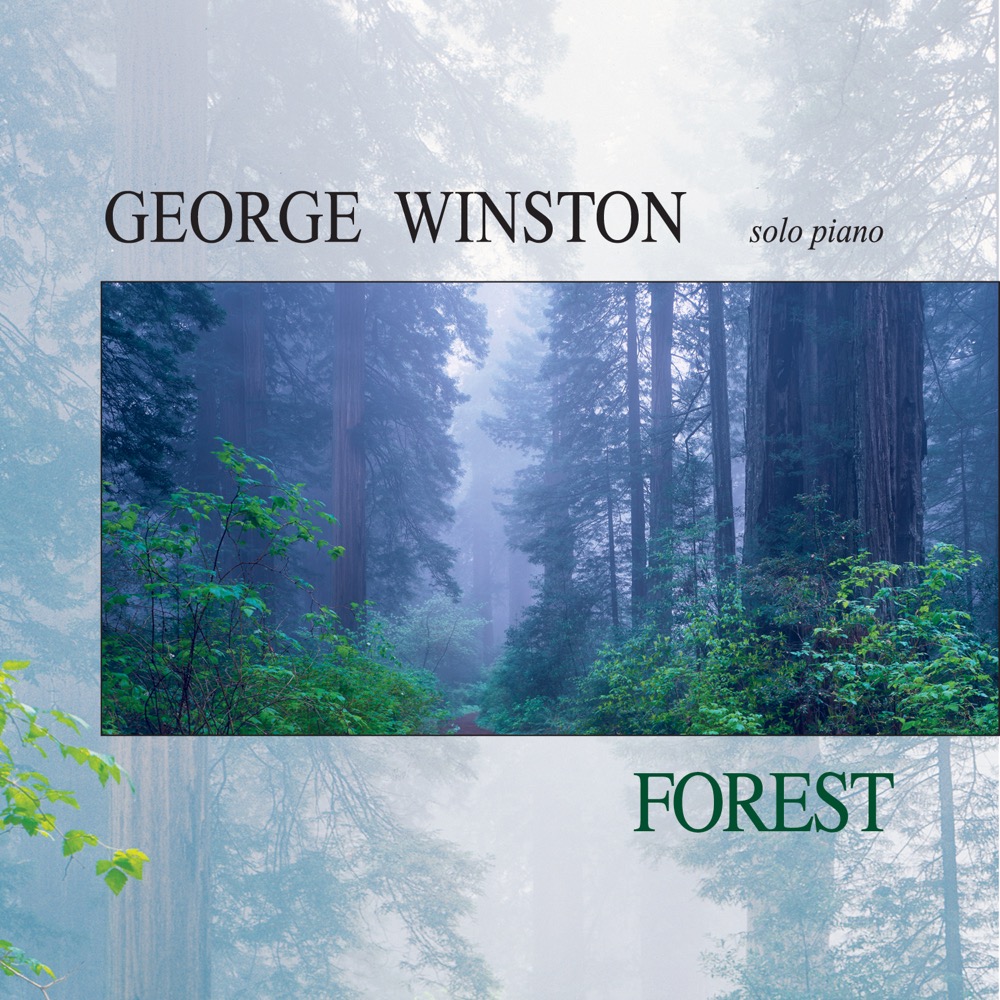
In 1996, Christmas came early for George Winston when he took home the Grammy Award for Best New Age Album.
This is NAGCHAMPA. That’s the New Age Grammy Challenge: Healing Assessments of Musicians Perceived as Awful. I’m listening to every album that ever won, or that was ever nominated for, the Grammy Award for best New Age, Ambient, or Chant album. Originally, I was doing this because I wanted to better understand just what this whole New Age thing is all about. Now I’m doing it because I really enjoy New Age music.
George Otis Winston III, who passed away in 2023, was no stranger to the Grammy Awards. As well as triumphing in the New Age category in 1996, he got a nomination for Best Children’s Music Album (for a collaboration with Meryl Streep!), and one for Best Contemporary Instrumental Album, for a collection of Doors songs reconsidered for solo piano. He looks just like Rufus from Bill & Ted in his Spotify profile picture.
George claimed that he always played in one of three styles: A New Orleans R&B kind of thing; a Fats Walleresque “stride piano”; and a melodic style of his own which he described as “rural folk piano”. He dabbles in all three styles throughout Forest, the album which won him his Grammy. But he mostly seems to stick to that “rural folk” sound. And what an evocative and affecting sound it is. Apparently, George first became interested in playing the piano having heard Vince Guaraldi’s soundtrack for A Charlie Brown Christmas. It shows; not just in his uplifting lyrical style, but also in just how Christmassy much of his work seems to be.
I make lists like this every year, and I finally understand why: It gives me the impetus to seek out new music throughout the year, rather than to just listen to stuff from decades ago. Because that’s the sort of thing I’d do, otherwise. This year’s Spotify Wrapped thing told me that my musical age is 70. The cheek!
“Music writers have a greater responsibility to write positive music reviews about outstanding works than negative hit pieces on bad music. The bad music will go away on its own. But good (and even great) artists often need a helping hand if their work is to survive.”
This is why, as per, I’ll be focusing on stuff that’s unlikely to get featured in many other end-of-year roundups. Because if I don’t who will?
There’s a game some people like to play whenever Coachella unveils the lineup of that year’s festival. You can work out your “musical age” by subtracting from 80 the number of names you recognise on the poster.
Based on the 2025 poster, my musical age is 46. But if I were to calculate it based on the number of acts I’d be interested in watching… hmm!
See for yourself:
The higher your “musical age”, the more you might relate to what follows.
Reminder: NAGCHAMPA = New Age Grammy Challenge: Healing Assessments of Musicians Perceived as Awful.
Following my foolhardy metal quest, I feel like I need some quiet and visionary music as badly as I sometimes need a cup of tea and a flapjack.
It’s been five years. But if you remember, I’m studying every album that ever won the Grammy Award for Best New Age Album, in an attempt to understand what makes New Age Music so New Age. The closest I came to a definition was this: New Age Music is applied ambient music. Or, it’s spiritual ambience. It’s music that aims to make you feel better, and succeeds.
But while my back was turned, the Grammy guys broadened the scope of this awards. Since 2023, the category has been “Best New Age, Ambient, or Chant Album”.
“Ambient” I get, but “chant”? Will there be chanting? Was there always chanting?
I swear, I had no idea that the 2025 Grammy Awards were taking place as I wrote this thing. The BBC didn’t even include the New Age category in their roundup of the winners. It looks like it went to Wouter Kellerman, Eru Matsumoto, and Chandrika Tandon’s Triveni. A worthy winner? We’ll see, when I finally get to 2025 in this project, some 16 years from now.
Because we’ve only just made it to 1994 here, and it’s Paul Winter’s time to shine.
The Monsters of Rock lay down their arms as a rabid dog approached the battlefield looking for a pat on the head. The Download Festival was born.
Why “Download”? Because at the time, people thought that downloading was killing music. So to label a music festival against such a force of evil was a daring move, presumably. Because that’s what metal’s all about: SHOCK. But it raises the question: If the Download Festival were started in 2023 rather than 2003, would they have called it the Streaming Festival?
I’ve only been once, and even then I only went for one day. It was 2019, and the opportunity to see Tool and Smashing Pumpkins on the same day was too good to miss. It was a beautiful day. Everyone was friendly, and everyone was there for the music. I saw more devil horns than smartphones held aloft, and the bars had the Iron Maiden Trooper ale on tap.
Also, Download has a mascot: The Download Dog. He started life looking like an unfortunate victim of experiments in canine ESP. Over the years, he’s also appeared as a sort of FrankenDog, as a snarling pink puppy, and as a skeleton. When he makes public appearances, though, he’s a giant red naked bodybuilder with studded bracelets who, despite his leer and his bulging muscles, looks to be quite cuddly.
All festivals should have a mascot. The Glastonbury Wizard. The Reading Bookworm. The Latitude Accountant. In fact, every business and brand in the land should have a mascot. They help, in a way.
So I’m down with The Download Festival. And that’s why I decided to listen to every band and artist that ever played Download Festival. What else am I going to do with my Spotify subscription?
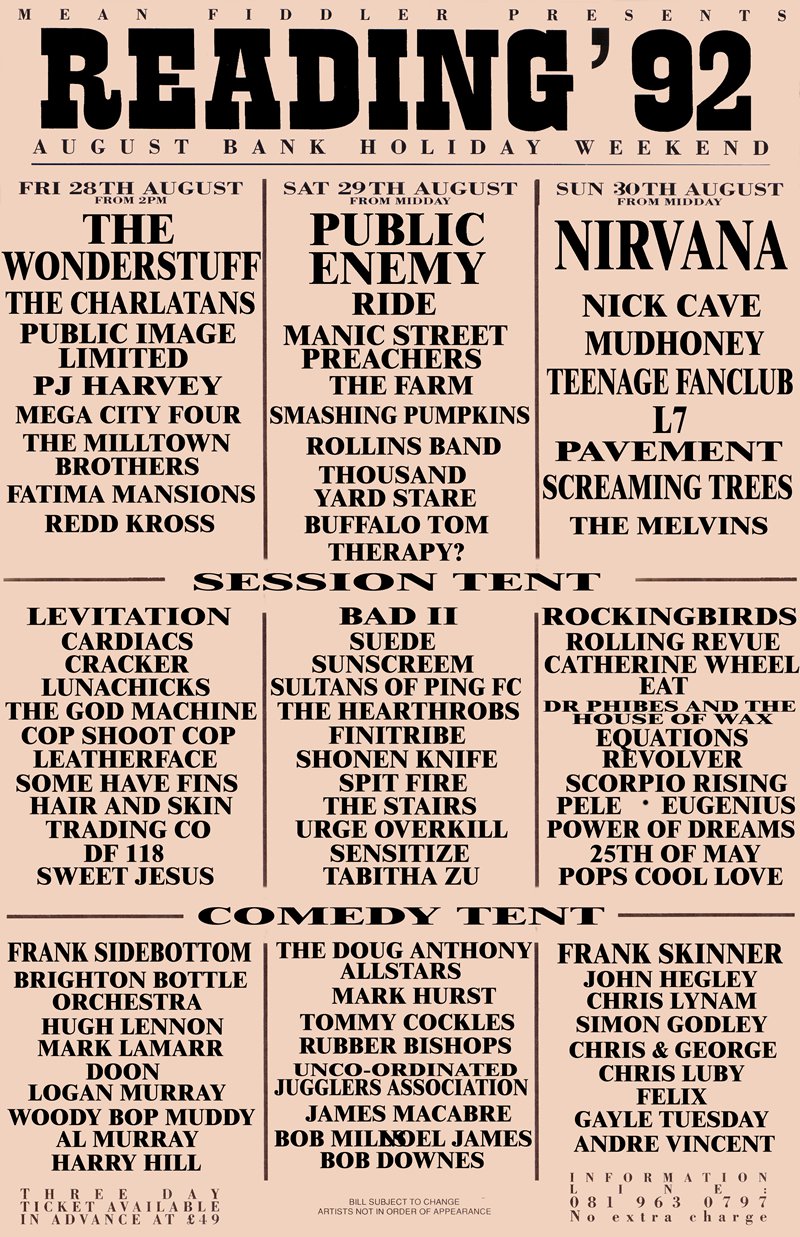
Every year, as the August Bank Holiday weekend approaches, the Shiiine On Festival shares an old Reading & Leeds lineup to their Instagram.
Something like this:
You can imagine the comments. Some just offer a single word. “Classic,” or similar. Some share fond memories. This is often something along the lines of, “I can’t remember much but I’m told I had a good time”. They were drunk, you see.
But others say something along the lines of “what happened?”
And you get similar comments whenever Reading and Leeds post lineup updates to their own social media profiles. “What happened?”
All Tomorrow’s Parties (ATP) was a series of festivals held between 1999 and 2016.
These festivals were remarkable for a number of reasons. First, their lineups were almost entirely hand-picked by a guest curator, who was usually a musician. Second, many of the festivals took place in the most refined environments possible – Butlin’s holiday camps! Yes, this means that for one glorious evening it was possible to see Patti Smith play on a stage usually used for knobbly knees contests.
Before things got quite so bad as they are now, bands used to put DVDs out.
Mostly these would feature a recording of a live performance. But sometimes they were collections of music videos, or even specially-made “behind the music” documentaries. The best music DVDs contained a combination of the above.
Each DVD is a time capsule of an era that was very similar to our own, but also profoundly different. This is the era just before the mass adoption of smartphones, and before social media made everyone and everything significantly worse.
Once you meet me, it’s only a matter of time before I try and make you a mix CD.
I still make mix CDs.
These days I only ever make mix CDs for other people. I used to make them for myself. I got my first MP3 player long after everyone else had got one, and I used it long after everyone else had moved on to streaming on smartphones. But before that, I made myself a lot of CDs.
It was my travelling music. I’d travel everywhere with a portable CD player (is that what we called them? Or was it a personal CD player?) and a wallet full of my own mixes.
I had a CD for every conceivable journey and every conceivable mood. I also had a reserve of CDs that I’d turn to when I couldn’t decide what else to listen to.
I followed certain rules when making these CDs – unconsciously at first, but they soon became very important indeed. And I realise that I still follow these rules when I’m making CDs for other people.
I also follow these rules when I’m putting playlists together. To some extent.
Let’s talk about the rules for making a good mix CD, together.
It was my l*ckd*wn project to listen to every single album from this book. And that’s the first and last time I’ll ever reference this atrocity of a year on this site.
Reader, I managed it. Shall I tell you what I thought?
The book was a gift, and I was interested in getting it because I wanted to hear some more music from before 1960.
The pre-1960 entries were wonderful. But if devouring this doorstop tome has taught me anything, it’s that, as far as I’m concerned, the 1960s were the best decade for music. By far. It’s not even close.
I enjoyed every single album from the 60s, and most of the albums from the 70s. But by the time I got to 1977 or so, things suddenly got a lot less friendly. Punk arrived, you see.
Things got even worse in the 80s, as the authors got preoccupied with hardcore punk (which is even more depressing than first-wave punk). Then things got genuinely unpleasant in the early 90s with the arrival of gangsta rap and g-funk.
There was good stuff throughout, of course. But the 60s offered wall-to-wall joy. Even the more challenging albums from this decade seemed imbued with warmth and optimism. And it often occurred to me that all music from 1970 onward owed a tremendous debt to this blessed decade. Even the stuff made by musicians suspicious or disdainful of the 60s wouldn’t exist without the musical miracles achieved in the 60s. After all, the 60s gave these cynical discontents something to rail against!
The book in question. Prince is on the back cover!
Moan, Moan, Moan
The selection of 1,001 albums is about as diverse a selection of albums as you could hope for. Though the selection’s strongly biased towards the west (and it’s obviously written from an American perspective), you can tell that the authors tried very, very hard to be as inclusive as possible.
Immersing myself in this book was an immensely rewarding experience. I heard many albums I simply would not have heard otherwise. Even better, I heard many things that I might previously have overlooked or written-off completely. In short, I’ve had a lovely time. Hundreds of hours of mind-expanding diversion. I couldn’t be happier.
But…
The blurb says that this book contains “inside knowledge and criticism from 90 internationally acclaimed music critics”. I’ve suspected for a while that you simply cannot be a professional music critic without also being a complete and utter melt. This book has given further evidence for my case.
Some of the entries are so dripping with disdain it’s baffling. Isn’t this meant to be a celebration of music? Then why the weird contempt for certain genres? Despite including two albums by My Bloody Valentine and one by Ride, shoegaze (or, as the book terms it, “shoe-gaze”) gets a lot of stick. And emo isn’t my thing. Never has been. But is the otherwise glowing review of Arcade Fire’s Funeral really the best place to write off the entire genre as “illiterate, self-indulgent, angst-ridden garbage”?
Elsewhere, British rap music is dismissed as an “unfortunate contradiction”. The writer doesn’t expand on this. They apparently assume we’ll nod along gravely. Hey ho. But if it’s an “unfortunate contradiction” that British people should wish to rap, why include, in your book, albums by Massive Attack, Tricky, Skepta, Dizzee Rascal and (hahaha) Happy Mondays and The Stereo MCs?
Plus, many assertions made throughout the book are simply wrong. For some reason, the entire entry on Suede’s Dog Man Star is dedicated to extolling the virtues of guitarist Richard Oakes, even though he had nothing whatsoever to do with the album’s recording. The title of The Arctic Monkeys’ debut album is said to be a quote from Billy Liar. It’s not. It’s a quote from Saturday Night and Sunday Morning. Sun It Rises by Fleet Foxes is said to be acapella. I don’t think they know what that word means. Kanye’s Beautiful Dark Twisted Fantasy is said to have “a notable absence of hokey skits and gimmicks”. So did I just hallucinate that interminable Chris Rock monologue about genitals?
Nitpicking? Maybe. But I only noticed these errors because I’m intimately familiar with the music in question. So who knows what other blatant falsehoods are hiding in the book?
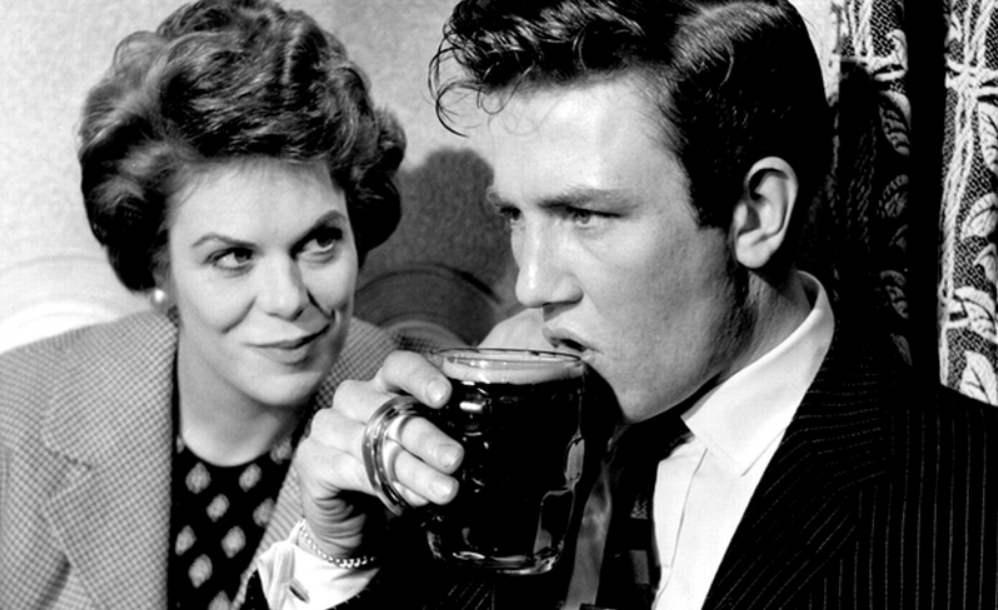
Albert Finney in Saturday Night and Sunday Morning (1961). “Whatever people say I am, that’s what I’m not.”
But What About….??!?!?
It’s inevitable that anyone reading this thing will think of countless albums the authors should have included. So let me list some of the omissions that annoyed me!
Jazz
Jazz features heavily in the 50s and the 60s, but very little beyond 1973 or so. Miles has a lot of entries, but John Coltrane and Charles Mingus only have one entry each. No albums are featured by Alice Coltrane, Sun Ra, Pharaoh Sanders, Art Blakey, The Art Ensemble of Chicago, Rahsaan Roland Kirk, Don Cherry, and Ornette Coleman’s only represented by an album of John Zorn covers.
Plus, Thundercat is the only representative of the new guard. Kamasi Washington, Robert Glasper, Badbadnotgood, Comet is Coming – nowhere to be seen!
Hip Hop
Admittedly, this isn’t really my cup of tea. But as I struggled through the seemingly endless collection of miserable gangsta rap albums, I couldn’t help but notice the absence of Souls of Mischief and Digable Planets. And I know the writers make their contempt for British rap clear. Still, they seem to respect The Mercury Music Prize, so I would have expected to see Young Fathers, Dave and Stormzy.
Electronic
Kraftwerk and Gary Numan are there, of course. There are a few techno, big beat and drum and bass albums featured in the 1990s section, and Mylo, Justice and The Avalanches are featured in the 2000s section. It’s a little surprising that they only feature one Daft Punk album (Homework) given how gargantuan and influential they proved to be.
IDM doesn’t get a look-in. It’s an unfortunate name for a subgenre that makes me cringe every time I encounter it. But the likes of Aphex Twin, Autechre, Squarepusher, Plastikman, Drexciya and Photek turned music inside out. They made music so out-there, so heady yet immediate, that to listen to it provides what feels like a deep tissue massage for your grey matter. But apparently, none of this music is really worth listening to. Hm!
Also notable by their absence: Four Tet, Gas (or anything from Kompakt), The Knife (I mean, really!), and, perhaps most shocking of all, Flying Lotus. And speaking of influential subgenres that might as well not exist as far as this book’s concerned – could they not even throw in a token vaporwave album?
Ambient
There are two ambient albums in the whole book. Two. One’s by Brian Eno, of course. The other’s by Aphex Twin. Yes, he’s included. But he’s included for one of his ambient experiments rather than for his mind-melting unclassifiable genius. And of the two ambient collections he’s put out, Volume 2 is profoundly superior to Volume 1. This book goes for Volume 1. I repeat: Hm!
And that’s it for ambient music. Nothing by The Orb, Biosphere, Stars of the Lid, William Basinksi, and so on, and so forth. And while I note the absence of Susumu Yokota, might I also point out that there isn’t a single album from East Asia in the whole book?
Plus, there’s not a single new age album in the whole thing. Not one. I know it’s a much-maligned genre. But how about a begrudging shout-out for Enya? Or some kudos for Laraaji, if the authors want to retain their credibility?
Reggae
You barely need two hands to count the number of reggae albums in the book. The selection’s limited to The Wailers (three albums by Bob, one by Pete), Burning Spear, UB40, and Finlay Quaye. There’s not a single dub album. I thought that certain albums by Lee Perry, The Upsetters, The Congos, Black Uhuru, Mad Professor, The Scientist, Augustus Pablo and King Tubby were canonical. Apparently not!
Metal etc.
Reading this book, you’d think that the only style of metal is thrash metal. Worse, you’d think that there’s been no good metal since nu-metal. Worse still, you’d think that nu-metal was actually worth listening to. Yes, the last HEAVY album included is Slipknot’s debut. So all the visionaries who’ve redefined what’s possible with LOUD guitars since 1999 may as well not have bothered. Never mind, Mastodon, Opeth, Deftones, Deafheaven, Boris, Sunn O))), Wolves in the Throne Room, Tool, and the rest, and the rest.
Incidentally – According to this book, one heavy album that you apparently must listen to before you die is Kid Rock’s Devil Without a Cause. And that album’s inclusion is the reason why I’ve only listened to 1,000 of the 1,001 albums listed!
“Indie” (For want of a better word)
The more I think about it, the more I realise that it’s a good job I didn’t put this book together. Because if I did, I would have filled it with bands who have enriched my life these past 20 years, such as Grandaddy, Broken Social Scene, Neutral Milk Hotel, Godspeed You! Black Emperor, Modest Mouse, My Morning Jacket, Bat for Lashes, Band of Horses, Interpol, Low, Snow Patrol, Keane, Starsailor, Explosions in the Sky, The National, Black Rebel Motorcycle Club, The Cooper Temple Clause, Franz Ferdinand, The Libertines, Clinic, The Coral, The Beta Band, and the rest.
I’m not surprised that some of those weren’t featured. But I’m very surprised that there wasn’t a single album by GY!BE, The National, My Morning Jacket, Modest Mouse, or Low. And I’m particularly surprised that they didn’t feature In the Aeroplane Over the Sea. Again, I thought such albums were canonical. Once more: Hm!
Other Omissions
Finally, there are some artists who have albums included in the book, but not necessarily the ones I’d expect to see. None of Scott Walker’s latterday devastating nightmares feature. Nor do any of Kate Bush’s releases this millennium. Bjork has three albums featured (four if you count The Sugarcubes), but not Post or Homogenic. Apart from Junkyard by The Birthday Party, none of Nick Cave’s 80s work is included. Tender Prey would be my pick for his finest album, and Your Funeral, My Trial is almost as essential as The Firstborn is Dead. There are two Bee Gees albums included, and neither of these albums is their soundtrack to Saturday Night Fever.
One oversight, though, is simply unforgivable: Mezzanine by Massive Attack. I wouldn’t mind, considering their first two albums are included. But if it was a question of space, there are at least two of the albums from 1998 that they might have replaced with Massive Attack’s masterpiece. One is that aforementioned Kid Rock atrocity. The other is a Bob Dylan live album recorded in 1966. As “important” as this performance undoubtedly was, are these guys really going to pretend that one of the best albums of 1998 was actually recorded in 1966? And are they going to do this while also including Kid Rock and excluding Massive Attack? And are they going to do all of this with a straight face, yeah?
Pictured: An unforgivable oversight.
You Can’t Please Everyone
And we all like to moan now and then.
For what the book is, it’s excellent. And I repeat – it’s provided hundreds of hours of mind- and horizon-expanding joy through some hopeless months. I guess it’s folly to try and compile a “definitive” list of essential albums from 50+ years of musical history. Oversights are inevitable. And most are forgivable!
But my real goal in listening to all of these albums was to create THE ULTIMATE PLAYLIST.
I now have a Spotify playlist featuring one song from every album featured in this book.
Sort of.
You see, creating this playlist provided me with an opportunity to right some wrongs. I made certain substitutions throughout. Some of these were necessary, when the album featured in the book wasn’t on Spotify. Other substitutions were made to make the playlist that little bit more enjoyable. For example, I prefer Roam by The B52s over anything from their debut, and There Must Be An Angel by The Eurythmics over anything from their debut. Plus, I didn’t want a Christmas song in my playlist, so I included a non-festive song by The Ronettes in place of something from Phil Spector’s Christmas Gift.
But some of my substitutions were merciless. I’m sorry, but I cannot stand Eminem or The Arctic Monkeys. Kanye’s Yeezus was a hideous chore. It’s a total joke that they included Django Django’s debut without including a single album by The Beta Band. And I really, really, really didn’t want to listen to that darn Kid Rock album.
I went rogue once, and only once, through replacing Kid-effin-Rock with a track from the real best album of 1998 – Mezzanine. So instead of hearing Kid Rock bark about being a cowboy, we now have Horace Andy lamenting his antisocial neighbour. It’s what Jesus would have wanted.
I won’t lie to you – not every song on this playlist is a winner. But such is the glorious scope of the book that there really is something for everyone. And you can rest-assured that, if you don’t like one track, you’ll probably like the next one.
Listen to it in sequence and you can track the gradual evolution of pop music from Frank Sinatra to Hookworms. But listen to it on shuffle and you’ll have a 72 hour mix of rock, pop, jazz, funk, punk, blues, soul, disco, hip-hop, trip-hop, electro, big beat, techno, grime, grunge, UK garage, US garage, psych, prog, country, folk, soft rock, hard rock, hardcore, grindcore, Britpop, post-punk, post-rock, post-hardcore, acid rock, acid jazz, acid house, both kinds of R’n’B, and beautiful lashings of glamorous indie rock’n’roll.
The best place to start is track 705, which lays down this truth:
Today on this program you will hear gospel, And rhythm and blues and jazz. All those are just labels. We know that music is music.
And that’s why, for all its many, many, many faults, this book wins. Because it proves that music is music.







 Lord Gloom