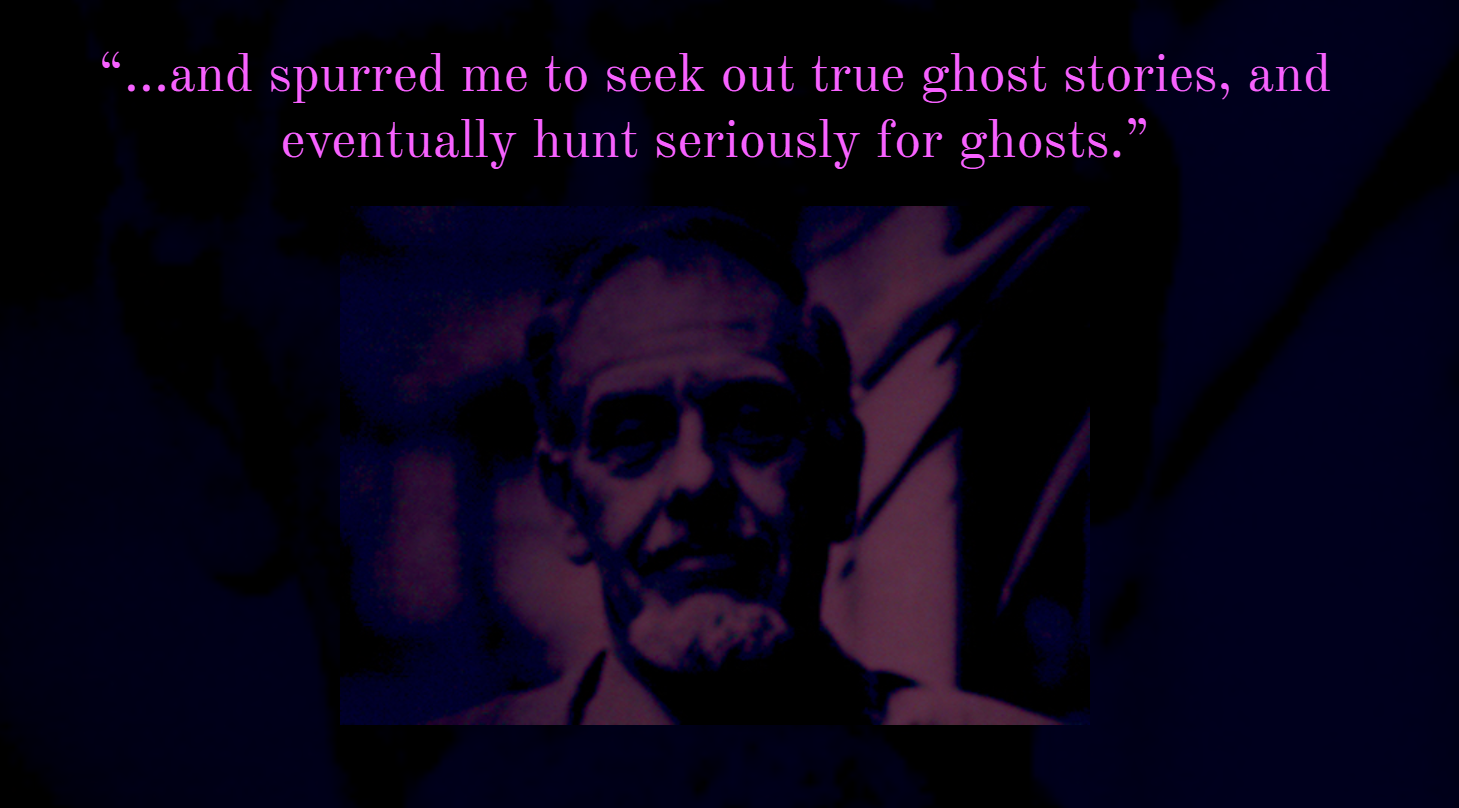
“It is hardly possible to talk to anyone these days without being told that they know someone who has had a ghostly experience. Whether we know when we have seen one is another matter.”
Aged nine, Peter Underwood woke up to find his father standing at the foot of his bed. This would be fine, except his father had passed away earlier that same day.
“Each night Father fills me with dread
When he sits on the foot of my bed;
I’d not mind that he speaks
In gibbers and squeaks,
But for seventeen years he’s been dead.”Edward Gorey, Amphigorey (1972)
This experience understandably resulted in a lifelong obsession with the paranormal. In 1946 Peter was invited by British psychic Harry Price to join the Ghost Club, an elite society of ghost hunters and psychonauts. Past members of the Ghost Club include Charles Dickens, W.B. Yeats, Peter Cushing, Algernon Blackwood, and Sir Arthur Conan Doyle. Peter would serve as president of the Ghost Club from 1962.

I’ve been reading Peter Underwood’s Nights in Haunted Houses (1993). The book details various overnight investigations, exorcisms, and séances, most of which Peter attended himself. Though these mostly take place in old castles, churches, and manors, there’s also a supremely creepy chapter featuring a Nottingham council house, and an account of a haunted WW2 bomber.
Peter details various ghost hunting techniques. As well as séances and planchettes, he also made use of chalk outlines, “trigger objects” (tempting trinkets that poltergeists might like to throw), and visual and audio recordings. He and his fellow hunters used to leave “cinefilm” cameras and tape recorders running for hours at a time, and it seems they often picked up some unexpected things. He mentions an overnight audio recording that featured hours of silence followed by the sound of a beating human heart, which rapidly built in intensity before the tape ran out. There’s also apparently a video recording in which you can hear an ethereal female voice saying something like, “It’s watching us.” The ghosts had spotted the camera.
Peter had an endearing habit of ending sentences with exclamation marks when describing spooky or inexplicable events. This gives some of the hauntings he discusses a loopy Scooby Doo feel. But nonetheless, some of the experiences he shares seem genuinely harrowing. Like the ghost that giggles whenever anyone spots it. And the invisible child that places its hand in yours (you feel the clutch of a tiny hand, but there’s nobody there). And the tragic tale of Isabelle, the vengeful spirit of a bastard child from Torquay.
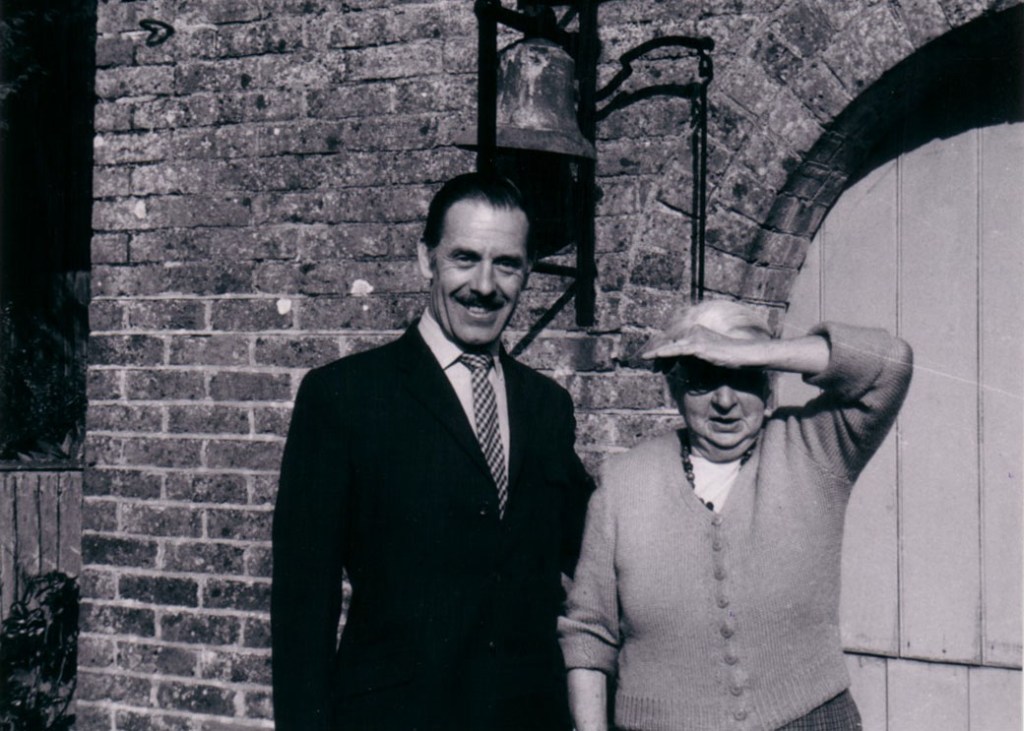
The book includes photos from some of these investigations. Whenever we see Peter himself, he’s usually wearing a sharp suit with a black tie. He has a thin moustache, immaculate hair, and he’s sometimes shown smoking a pipe or a cigarette in the middle of an investigation. So it basically looks like the 13th Duke of Wybourne has just wandered into a séance.
“Me? Britain’s pre-eminent paranormal investigator? Talking to the dead at Borley Rectory? With my reputation?”
And so on.
In his 1983 autobiography, Peter concluded that 98% of reported hauntings likely have a “naturalistic” explanation – pranks, hallucinations, and so on. The other 2%, though, he attributed to genuine paranormal activity. And in Nights in Haunted Houses, he shares some interesting theories on how ghosts “work”.
They’re like batteries. They draw from ongoing human activity to “charge up”, and they manifest once they’ve built up enough energy to do so. And like batteries, entities can lose their charge over time, which explains why certain hauntings ultimately wind down.
“There’s a weird and wonderful something here
That rules when darkness falls
And those with eyes can see things
That have happened between these walls.”Peter Underwood, ‘Night at Borley Rectory’ (1947)
One thing I noticed when reading Nights in Haunted Houses is that many hauntings involve ghostly monks and nuns. I’d like to share a ghostly theory of my own.
Why do so many ghosts look like nuns and monks?
I think it’s for three reasons:
1. The life of a monk or a nun is full of routine. You might do the same basic tasks in the same order again and again and again, potentially for decades. Old habits die hard – or maybe they never die at all. Perhaps if you perform any action often enough, the behaviour will become so ingrained that you’ll continue to go through the motions long after you die.
2. Not everyone chooses the monastic or the covenant life, and such a life isn’t for everyone. Austerity. Celibacy. Silence. Loneliness. Ghosts may linger because they have unfinished business; something they failed to achieve in life that makes them reluctant to leave this plane of existence. Maybe those ghostly monks and nuns are clinging to this world because they don’t feel they saw enough of it during their living years.
3. Some ghosts are glimpsed out of the corner of the eye, and others are perceived as fuzzy shadows in gloomy spaces. If you see something vague and you perceive it to be human, maybe your brain will fill in the details: You’ll eventually recall that indistinct outline as the folds of a cowl or a habit.

PeterUnderwood.org – The Best Website In The Universe
Peter passed away in 2014, but you can still visit his website. It’s delightfully old school, with a caricature of Peter that blinks into life like the ghost he’s surely become, and a multimedia journey through his life and work filled with choice quotes and eerie flashing images. Take a chilling journey into the unknown, today!
There’s also an official Peter Underwood YouTube channel. This mainly features trailers for Audible editions of his many publications. But there are a few choice archive recordings in there too.
“It so happens my grandparents lived in a haunted house…“
Happy Halloween.
And happy hauntings, Peter.
NOTE: The header image is taken from “The Derelict Mill” section of Peter’s wonderful website.
 Lord Gloom