Without looking, what album do you think Wikipedia uses to illustrate their entry on “the album”?
Abbey Road? Pet Sounds? The Dark Side of the Moon? Or perhaps something more contemporary, like Wild God, or one of the 63 albums King Gizzard & the Lizard Wizard put out last week?
Go on, take a guess. For you’ll never guess. Nope. Not in a million years.
Give up? OK.
The album Wikipedia uses to illustrate their article about “the album” – the album which might therefore be considered the quintessential album – is Hey Petrunko (2003), the independently-released second album by Ooberman.
Here’s a screenshot, just in case someone changes this image between my time of writing and your time of reading:
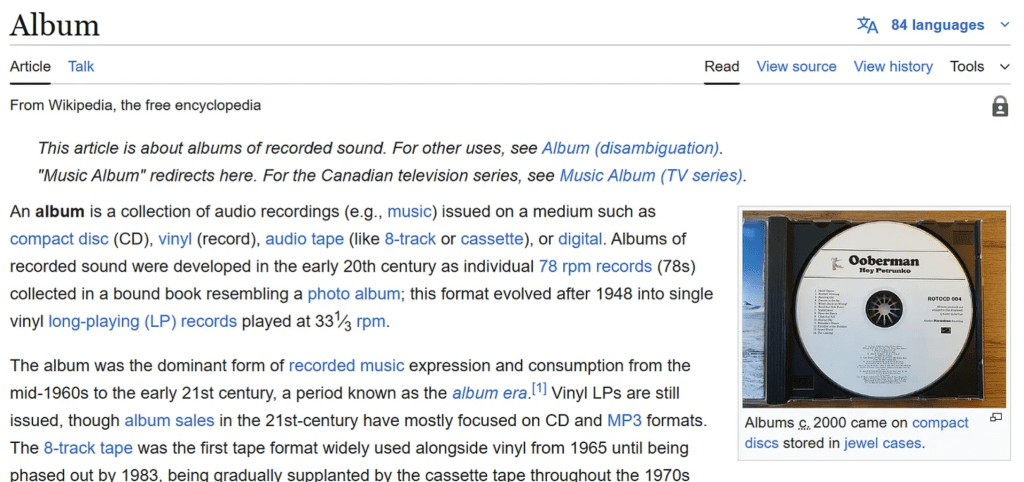
Granted, this is but one of a number of images used on Wikipedia’s entry on “the album”. Scroll down the page and you’ll also see a Thaikovsky 78, a picture of a vinyl LP, a “typical” 8-track tape player, a blank cassette tape, the CD of Led Zeppelin III, and a photo of an orchestra in a studio.
But that Ooberman album is the first image you’ll see, accompanied by the caption “Albums c. 2000 came on compact discs stored in jewel cases.”
Why this album, instead of literally any other album? I realise it’s possible to get an insight into the editorial process on Wikipedia. But I’ve heard that to delve into such haunted vaults is to invite gibbering madness into your mind.
And besides, I don’t think I want to know when and why the spirits of Wikipedia chose this album in particular to illustrate their article. As long as I don’t know the true reasons for this choice, I can tell myself that this is the work of an Ooberman ultrafan, diligently carrying the torch for their favourite band by whatever means necessary.
Do you know Ooberman?
If you are unfamiliar with Ooberman, you could do much worse than visit their website. Rumour has it that this site once featured pictures of cats along with a tribute to the noble haulage firm Eddie Stobart. Now the site is but a single page featuring a short history of the band, pictures of mermaids, and a discography.
And at the top of the page, words that fade into view and flitter away, like a sigh from a ghost:
Let me close my eyes and lie invisible and perhaps the clouds will pass through me.
We learn that Ooberman was formed by “singer-songwriter, multi-instrumentalist, and all-around musician Dan Popplewell”. What is an “all-around” musician, and how does this differ from a “singer-songwriter” and a “multi-instrumentalist”? It’s not made clear.
Dan formed a band with his friend Andy Flett in Bradford, called the Forestry Commission. Dan soon moved to Liverpool, causing the Forestry Commission to fall. But Andy, and his younger brother Steve, would eventually relocate to the North West too, and thus was Ooberman born. Their mission? To play “cowboy-boot music”, as opposed to “trainer music”. That is, music that’s “out of step,” rather than golden country sounds.
You will often see Ooberman referred to as a “Liverpool band”, as they were formed in said city. Which is fair enough. But come on, Liverpool: You already have thousands of bands to call your own. Why not let Bradford have this one? Who else have they got? The Cult, New Model Army, Terrorvision, and a number of reality TV contest winners. I say they deserve to call Ooberman their own, too.
Two Liverpool natives would eventually bolster Ooberman’s lineup: Sophia Churney on vocals and keyboards, and Alan Kelly on drums. So one could argue that there’s sufficient scouse DNA in Ooberman for them to qualify as a Liverpool band. But if the band were ever deemed worthy of a blue plaque or a statue, I’d still argue that Bradford has a greater claim to host such a monument than Liverpool.
Ooberman’s first big break came in 1998. Graham Coxon heard the band’s demo, and liked it so much he released their debut single, Sugar Bum, on his own label.
1999 then turned out to be a big year for Ooberman. They recorded a couple of Peel sessions, they performed at Glastonbury, and their single, Blossoms Falling, was a Top 40 hit (it got to #39). And throughout the year, The Manic Street Preachers apparently used the title track from the Shorley Wall EP as their walk-on music.
A note about Blossoms Falling: It’s a sweet and soaring technicolour dream of a song, a ride over the disco rainbow on the back of a unicorn with strawberry laces for hair. I now know the band’s name is a play on Nietzsche’s Übermensch. But when we first heard Blossoms Falling on a compilation c.2000, it sounded so wonderful that I thought that an Ooberman must be some kind of friendly bubble robot, like a marshmallow version of the Michelin Man.
After releasing their debut album towards the end of 1999, things went a bit wrong for Ooberman. The new millennium started well enough, with an NME award for Best Live Performance. But in June their label dropped them, seemingly on account of poor sales. They tried it on with Rough Trade, but the relationship didn’t last. Most subsequent releases were on Rotodisc, Danny Popplewell’s own label. Which brings us to Hey Petrunko, Ooberman’s second album and, per Wikipedia, the quintessential CD album.
Hey Petrunko is named after a Bulgarian folk song. It’s title is not, as I originally thought, a reference to Hey Pachuco, the song Royal Crown Revue play in The Coco Bongo Club in The Mask. The album was due for release in 2002, but would be delayed until the following year. It didn’t quite make the Top 40 in the UK Independent Albums Chart (it got to #41). And after it failed to sell enough copies to cover the band’s expenses, Ooberman broke up.
There would eventually be a third album by a reformed Ooberman in 2006, plus a compilation of rare recordings the following year. There would also be a side project, The Magic Theatre, featuring Danny and Sophia, with Danny repurposing tunes he’d originally written for film and TV as a canny means of getting lush orchestration for free.
But all of this is immaterial. Hey Petrunko has been recognised by Wikipedia as the quintessential CD album. Millions would argue that this is a much greater achievement than a long and successful music career could ever hope to be.
If you listen to Hey Petrunko now, will become clear just why the spirits of Wikipedia honoured it so? I don’t know, because the album is not available to listen in its entirely anywhere online.
There are a few songs available on YouTube. Here’s Cities That Fall, on which Sophia takes lead vocals. Big crunchy guitars mixed with strings that sound vaguely Eastern European – this to me sounds a lot like The Delgados circa Universal Audio:
And here’s Petrunka’s Dream. This one’s pretty ethereal, with gently plucked guitars, muttered vocals, celestial horns, and yawning gaps between its various sections. It’s like a kaleidoscope in soft focus, or a memory glimpsed through a fish-eye lens:
First Day of the Holidays was one of the singles lifted from the album. I feel like this would be a very useful song to listen to if you needed cheering up, quickly. But then you listen to the lyrics, and suddenly you want to hold everything that matters to you as close to your chest as possible:
When I awoke I was ten again
And the heat rose in the fields again
And the sun rose in the haze again
And it was just the way it used to be
And you were alive again
When we ran through the woods again
There was sunlight on the stream again
Just like the first day of the holidays
As the years go by
All the strings we tied that connected us to home
Pull us back like elastic bands, only everything is gone
Running Girl was another single, and this time we have a music video to work with! It’s home video footage from the year 2000 showing a wedding. Given the title of the album I’m going to guess this was filmed in Bavaria:
Another haunting song. It might remind you of Saint Etienne, but I don’t think Saint Etienne ever got quite so crunchy or shouty as this one gets towards the end. “Watch me run!”
According to the description attached to the YouTube video: “Dan wrote this in 30 minutes at 3am on a Saturday night when living in the studio, after going out and running around the Liverpool town centre on his own, weaving through the drunken chaos for fun… You should try it!”
Bluebell Morning, was another single, so we have another video to watch. This time they’re auditioning dancers. Get ready for star wipes:
This one achieves something rather rare: It has a chorus so big, so simple, and so catchy that you’ll be able to sing along perfectly by the end of your first listen. And I do believe that, had I first heard this in 2002, by now I’d rank it among my favourite songs.
Finally we have Dolphin Blue, which appeared on an expanded version of the album the group released in Japan. This was originally a standalone single, and the band’s only release on Rough Trade records. It’s a fine song, as salty and vaguely unnerving as a fortune teller’s tent at the end of a pier, and the video might remind you of a certain demented Marc Almond album cover:
We can also watch this short, 10 minute documentary about the album, which presumably first appeared on a bonus DVD:
There are a number of snippets of music throughout, which surely give us a taste of how the rest of the album may sound. As Dan discusses his creative process we get to enjoy his, and his band members’, lovely northern accents. Dan does sound more Liverpudlian than Yorkshire. Maybe the city rubbed off on him.
Says Dan:
“I would like Ooberman to be seen as a cherished band. A band of songwriters saying something relevant, which is recognised by the wider tribe of humanity that these people are saying something that everyone can look back on and go, ‘Yeah, you know fair enough mate, yeah, thanks for drawing that to my attention. I feel the same way too now and again.'”
Oh, my heart.
This has been a bittersweet experience, yet it’s a story we’ve all heard thousands of times before: A quirky band with astounding sounds does everything right, only to get almost totally ignored. The least we can do is keep listening to such music, and keep talking about it.
And we can also spend half an hour watching this fuzzy recording of Ooberman performing live in 1999 at the L2 Liverpool, supporting Gomez. They open with Sugar Bum, and then play Blossoms Falling. It’s wonderful:
If you’re interested in learning what Gomez played that night, and I know you are, take a look.
Interestingly, having been inactive for 10 years, this video, along with a couple of others, was uploaded in the past week or so to an official Ooberman YouTube channel.
Are they back? Did they ever really leave?
Maybe the group just noticed their album at the top of that Wikipedia page and thought, hey, let’s remind the world of what they’ve been missing.
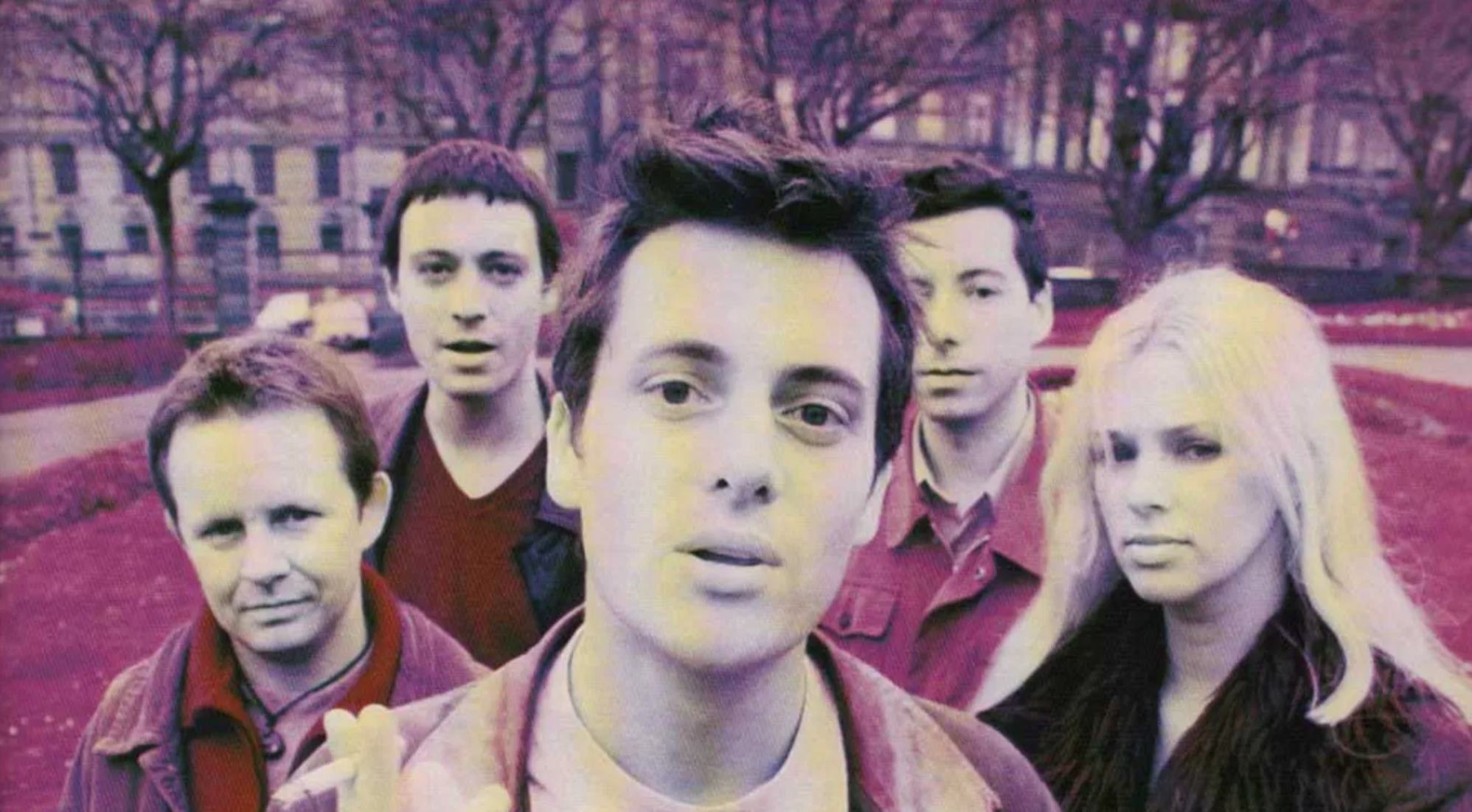
NOTE: The header image from this post comes from this ancient Select magazine feature. The scan is part of a bigger project to create digital versions of numerous Select features. You can spend a happy afternoon or two here.
 Lord Gloom